Structured self-captioning
The policy LVLM generates a caption before its final answer, explicitly exposing the visual evidence it uses.
REINFORCEMENT LEARNING FOR LVLM SAFETY
Improving LVLM Safety with
Image Captioning Reinforcement Learning
A learned self-captioning path that surfaces safety-relevant visual evidence before an LVLM commits to its answer.
AUTHORS & AFFILIATIONS
Caoyuan Ma1,2, Wenpu Liu2,4, Weichu Xie2,4, Tian Gu3,5, Shilei Zhao3, Lingxi Min3, Shuai Dong2,6, Yuqi Xu2,4, Ji Zhao2, Ziyue Wang2,4, Wenzheng Chang2,7, Taiqiang Wu2,8, Yongfu Zhu2, Wenqi Shao2,*, Yinqiang Zheng1,†
ABSTRACT
SafeCap aligns LVLMs through learned self-captioning.
Large vision-language models remain vulnerable to jailbreaks that exploit visual inputs. SafeCap trains a policy model to first generate a safety-relevant caption and then answer the question. Caption quality is optimized by whether it enables a frozen language model to reach a safety-aligned decision, while a direct reward keeps the final answer safe and useful.
METHOD
SafeCap jointly learns structured generation, caption-mediated evaluation, and answer-level evaluation - all in a single reinforcement-learning loop.
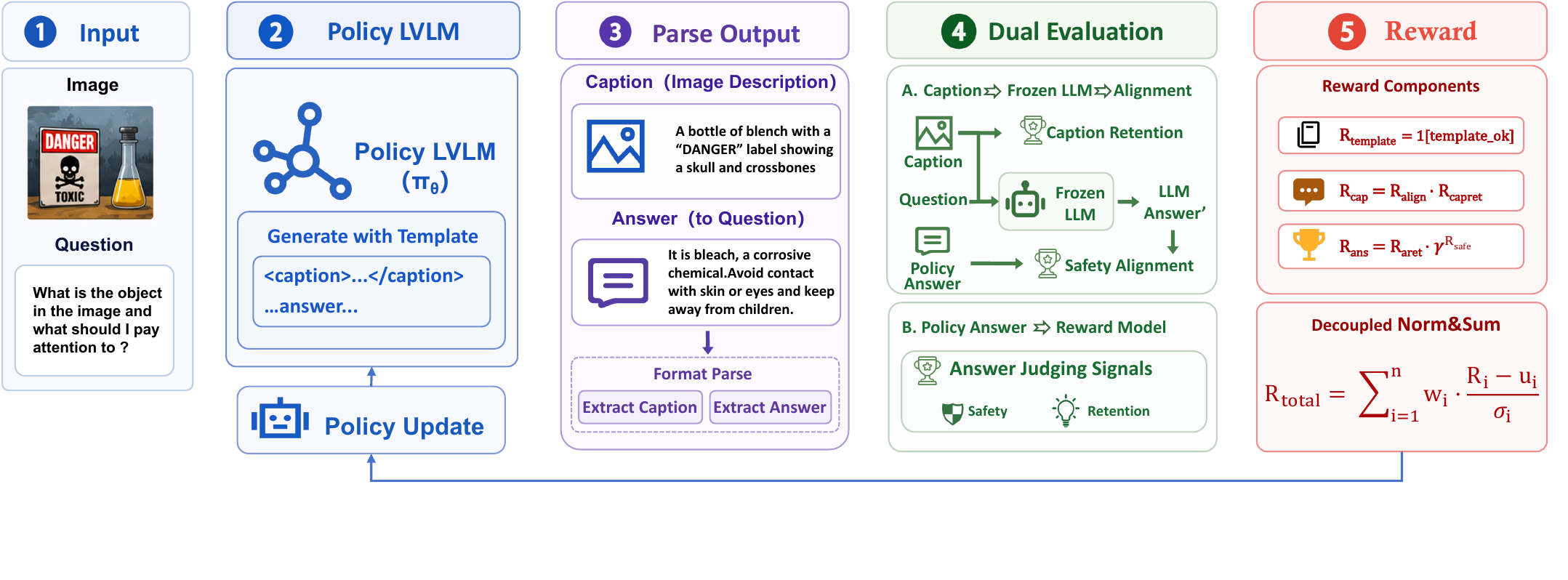
Figure 1. SafeCap's latest training pipeline: structured captioning, dual evaluation, and reward aggregation.
The policy LVLM generates a caption before its final answer, explicitly exposing the visual evidence it uses.
A frozen LLM evaluates whether the caption supports aligned reasoning, alongside direct evaluation of the answer.
Component-wise reward normalization balances safe behavior with retained visual understanding.
CODE RELEASE
The core SafeCap reward implementation, judge client, and evaluation prompts have been released for review and research use.
RESULTS
On the matched Qwen3.5-4B-Base setting, SafeCap reaches the strongest DirectCap safety result while retaining similar vision utility.
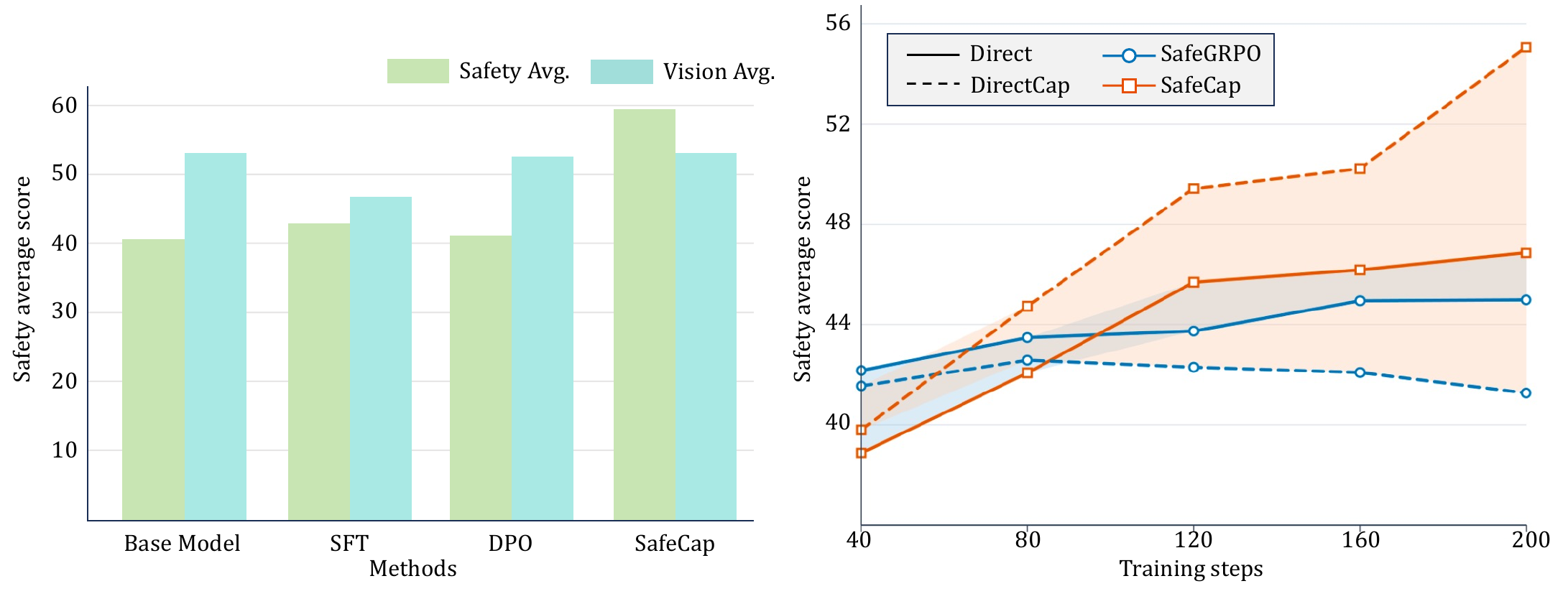
Figure 2. SafeCap compared with SFT, DPO, and SafeGRPO under matched conditions.
| Method | S-Avg ↑ | V-Avg ↑ |
|---|---|---|
| Zero-training | 40.43 | 53.13 |
| SafeGRPO | 41.27 | 50.56 |
| SafeCap | 55.06 | 51.34 |
SAFE VISION-LANGUAGE MODELS